















Raster-Scan for Calibration of DNS Antennas

Paul H. Richter and David J. Rochblatt

Introduction

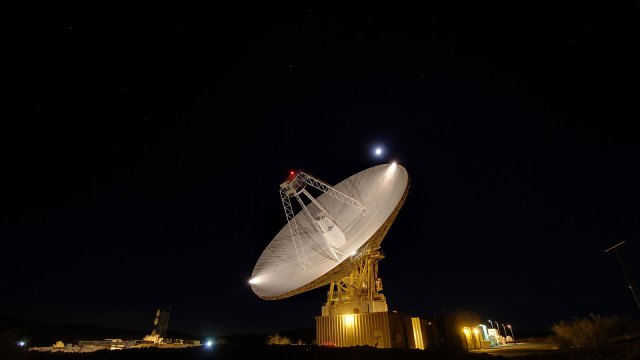
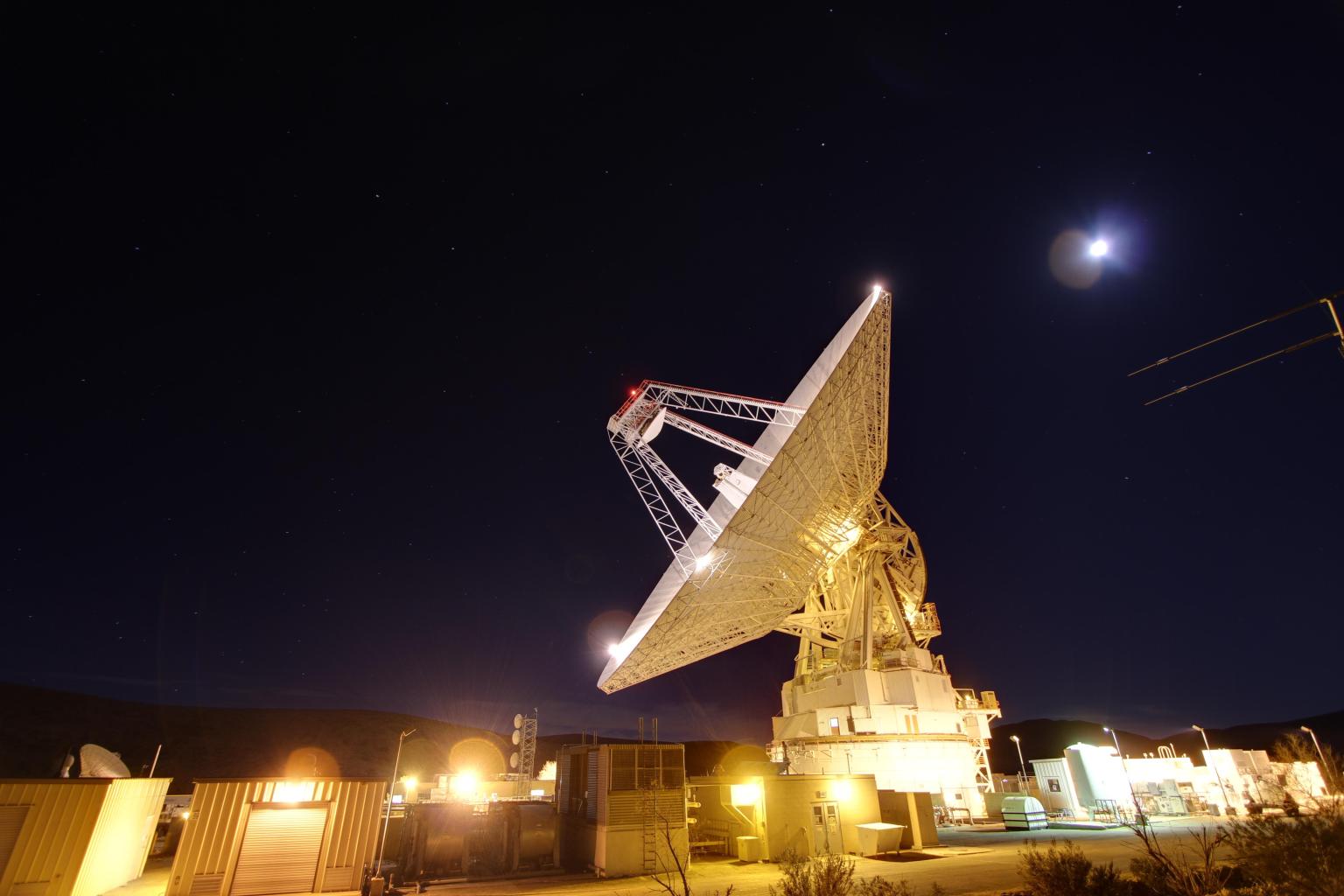
NASA's Deep Space Network (DSN) of large radio antennas provides the basic communications links with the many spacecraft that form part of the nation's unmanned space exploration program. In order to satisfactorily carry out this mission, each antenna must undergo various calibrations to insure that it is operating in the most efficient manner possible, and delivering maximum information at minimum cost.

As part of the strategy to improve the overall performance capability of the DSN, there has been a steady increase in the operating frequencies of these antennas, over the years, going from S-band (ƒ = 2.3 GHz), to X-band (ƒ = 8.4 GHz), and most recently to Ka-band (ƒ = 32 GHz). One can gain a better appreciation of the implications of these frequency increases for antenna calibration, by considering the corresponding wavelengths of the radiation. Thus, for S-band l = 13 cm, for X-band l = 3.6 cm, and for Ka-band l = 0.9 cm. Since the essential performance characteristics of an antenna, such as pointing capability and aperture efficiency, are strongly dependent on the wavelength of the radiation being detected, one sees that the more than 14:1 decrease in this parameter has resulted in the need for much greater precision of such parameters as reflector surface figure, azimuth track smoothness, subreflector and beam waveguide (BWG) mirror alignments, etc.

The first, and most important step in any calibration procedure is the accurate measurement of the various parameters of interest. In the case of antenna calibration, these fall into two categories; namely, those derivable from the measurement of amplitude and phase of a received coherent microwave signal, and those derivable from the measurement of received power from a noncoherent source such as a radio star.1 The former case involves the interference of received signals from the antenna under test (AUT), and a small, reference antenna mounted nearby, using a technique known as microwave holography, while the latter utilizes a total power radiometer (TPR) measuring system to determine the antenna temperature of the source.

In both cases, it is necessary to mechanically scan the antenna beam past the source in some manner. The way this is accomplished turns out to be crucial to the success of the measurement.

In the following section we describe the scanning process in more detail and consider the merits of the so-called raster-scan method over other approaches.

Scanning a Radio Source

For the microwave holography measurements, the desired products are the actual deviations of the antenna main reflector panels from the ideal surface corresponding to the correct main reflector figure, and deriving the best subreflector position relative to the antenna main reflector. Since this information is obtained from the two-dimensional Fourier transform of the two-dimensional amplitude and phase data obtained as the antenna beam is scanned, relative to the source, a square scanning pattern suggests itself as being the simplest in terms of both data analysis and mechanical motion of the antenna.2

For the TPR measurements, the desired products are the peak temperature corresponding to the source, the pointing offset when the antenna is commanded to the source, and the shape of the antenna beam main lobe. These parameters, in turn, permit one to calculate the antenna aperture efficiency, by comparing the measured peak temperature with that expected for a 100 percent efficient antenna, the mechanical pointing error resulting from small misalignments of various parts of the antenna structure, and subreflector and other mirror misalignments.

Regardless of the scan geometry chosen, it is necessary to make these measurements as a function of antenna beam elevation and azimuth so that the dependence of antenna performance on these angles may be determined and compared with that expected from theory. For the microwave holography measurements, the source is typically a geostationary satellite beacon.

On the other hand, for the TPR measurements, the sources must be tracked across the sky during the measurement period so that obtaining good angular resolution in elevation and azimuth, as well as good all-sky coverage for pointing model determination, requires relatively short measurement periods, thus implying relatively fast scans. Here we encounter one of the main problems with collecting these kinds of data.

In the traditional, or boresight approach, the antenna is stepped from one point to another along a given direction, relative to the source, and data taken while the antenna is maintained at each fixed position, relative to the source. In order to determine the peak temperature, offset, and antenna beamwidth corresponding to this direction, the temperature data corresponding to five or seven points are used to determine a best-fit gaussian function that approximates the main beam shape. The calculated offset from this fit is then used to determine the set of coordinates for the next, orthogonal stepping. The process is repeated as the source is tracked across the sky.

This process suffers from a number of deficiencies, the major one being that a typical, large antenna structure takes on the order of 20 seconds to settle down to a stable position or angular velocity after being commanded from one offset to another. Thus, the stop-and-go nature of the process results in considerable error in position for each data point. This translates directly into errors in the estimates of peak antenna temperature, pointing offset, and main beamwidth obtained from the fit parameters. A second, and related problem is that the instability of the total power radiometers used to measure antenna temperature dictates a short, rather than long measurement time for each direction, in order to minimize measurement noise, and this is at odds with the need to wait 20 seconds or more for the antenna to settle down before making a measurement.

A third problem is that many natural radio sources used for antenna calibration purposes are only approximately point-like, with the result that a given antenna may not collect all of the radiation emitted by the source, i.e., the antenna may partially resolve the source structure. In such cases, one must estimate how much of the total known radiation from the source would actually be collected by the antenna under test at the frequency being used if it were 100 percent efficient. The resulting estimate, leading to a source-size correction factor, introduces another degree of uncertainty to the measurements, which one would prefer to avoid, if possible.

It is indeed possible to avoid this additional error source, and at the same time greatly improve the overall measurement accuracy, by using a raster-scan approach to the measurements, rather than the single-line stepping method described above.

The RASTER-SCAN METHOD

The key to this approach is to maintain a constant, known angular velocity of antenna motion during the taking of data along a given direction. During this time, the TPR output is sampled at a constant, known rate so that the relative position at which the data are taken is known with high accuracy, and antenna settling time is no longer an issue. Since the data are taken " on the fly," the integration that occurs during the sampling interval results in an attenuation of high frequency information, but this can be recovered by an inverse filtering process (Wiener filter).

Fig. 1 temporarily unavailableA second important aspect of the method is that the source is scanned in a raster, or TV-type pattern by stepping from line to line, so that a complete data set corresponding to a complete raster contains all of the relevant data and not just a sampling of it along two orthogonal directions. This means that one is effectively including all of the source radiation so that no source-size correction is necessary. The resulting two-dimensional data set may then be used to determine, by means of least-squares fitting, the best-fit main beam pattern, from which the relevant calibration parameters may be directly determined (Figure 1).

Tests run at DSS-13 have shown that the raster-scan method has the potential to significantly improve the accuracy of antenna calibration measurements in the DSN. For example, typical boresight data, obtained by stepping the 34-m antenna and measuring total power at X-band, show an uncertainty of 1-2 mdeg in the determination of pointing, and 0.14 K in the determination of the peak antenna temperature for a given source, while measurements carried out using the raster-scan technique have yielded corresponding uncertainties of as little as 0.1 mdeg and 0.03 K.

The challenges for the future include applying the method to the calibration of the BWG antennas at DSS-26 and DSS-25. The latter is of particular significance, as it has been selected as the Ka-band station for various Cassini radio science experiments, which demand the highest blind pointing accuracy. Studies currently under way are directed at assessing the rapid scan capabilities of the antenna elevation and azimuth servo systems to determine the maximum data rates achievable with raster-scan.

Other articles in this issue... Last Update: July 22, 1998
Webmaster: Christopher R. Hawley
Production Assistant:Cruzita Abellana